
SCIENCE & RESEARCH
The Science Behind
Nootropic Metabolic Wellness
Explore the peer-reviewed science behind Nootropic Metabolic Wellness—and discover why stress, cognition, appetite, metabolism, and daily performance are more connected than most people realize.
CONNECTING THE SCIENCE
The Science Connecting Stress, Cognition & Metabolic Health
Growing scientific evidence shows that stress, cognition, appetite regulation, metabolism, and daily performance are closely interconnected rather than separate aspects of health. These biological relationships help explain many of the wellness challenges experienced throughout the modern daily grind.¹¹⁻¹⁴
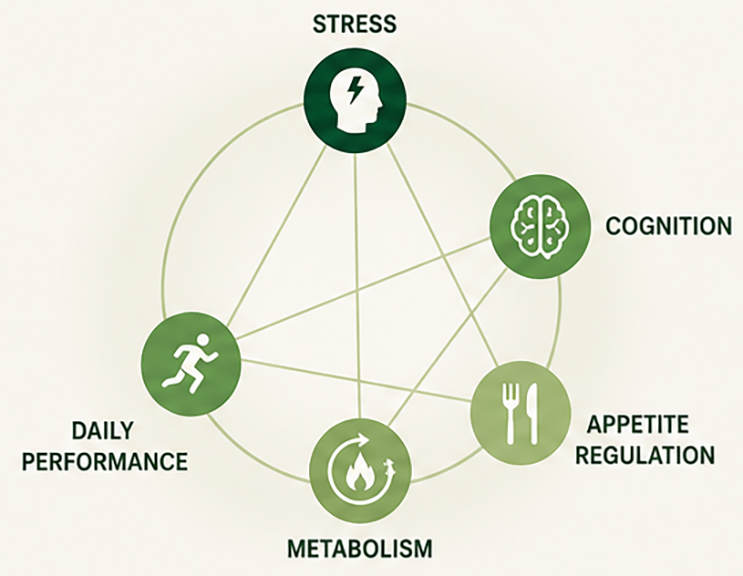

Rather than treating cognitive performance and metabolic wellness as separate goals, these categories reflect a more integrated understanding of modern wellness—one that recognizes the interconnected relationship between stress, cognition, appetite regulation, metabolism, and daily performance.

Each formulation reflects AgaraLife’s philosophy of combining well-researched ingredients that complement one another within a broader formulation approach. Accordingly, this research library is organized into related scientific topics, connecting the evidence behind individual ingredients with the biological systems and wellness outcomes they were selected to support.
Explore the Research by Topic
To make the science easier to explore, the research has been organized into related scientific topics based on the biological systems and functional ingredients they help explain. Together, these categories connect the evidence behind individual ingredients with the broader scientific understanding that inspired Nootropic Metabolic Wellness.

1 Docherty S, Doughty FL, Smith EF. The Acute and Chronic Effects of Lion’s Mane Mushroom Supplementation on Cognitive Function, Stress and Mood in Young Adults: A Double-Blind, Parallel Groups, Pilot Study. Nutrients. 2023. PMID: 38004235, PMCID: PMC10675414, DOI: 10.3390/nu15224842.
2 Camfield DA, Stough C, Farrimond J, Scholey AB. Acute Effects of Tea Constituents L-Theanine, Caffeine, and Epigallocatechin Gallate on Cognitive Function and Mood: A Systematic Review. Nutrition Reviews. 2014. PMID: 24946991, DOI: 10.1111/nure.12120.
3 Hausenblas HA, Saha D, Dubyak PJ, Anton SD. Saffron (Crocus sativus L.) and Major Depressive Disorder: A Meta-analysis of Randomized Clinical Trials. Journal of Integrative Medicine. 2015;13(4):231-240. PMID: 24299602, PMCID: PMC4643654, DOI: 10.3736/jintegrmed2013056.

4 Bortolin RC, Vargas AR, Ramos VM, Gasparotto J, Chaves PR, Schnorr CE, Martinello KDB, Silveira AK, Gomes HM, Rabelo TK, Grunwald MS, Ligabue-Braun R, Gelain DP, Moreira JCF. Guarana Supplementation Attenuated Obesity, Insulin Resistance, and Adipokines Dysregulation Induced by a Standardized Human Western Diet via Brown Adipose Tissue Activation. Phytotherapy Research. 2019;33(5):1394-1403. PMID: 30868680, DOI: 10.1002/ptr.6330.
5 Torres EAFS, Pinaffi-Langley ACDC, Figueira MS, Cordeiro KS, Negrão LD, Soares MJ, Silva CP, Alfino MCZ, Sampaio GR, de Camargo AC. Effects of the Consumption of Guarana on Human Health: A Narrative Review. Comprehensive Reviews in Food Science and Food Safety. 2022;21(1):272-295. PMID: 34755935, DOI: 10.1111/1541-4337.12862.
6 McLellan TM, Caldwell JA, Lieberman HR. A Review of Caffeine’s Effects on Cognitive, Physical and Occupational Performance. Neuroscience & Biobehavioral Reviews. 2016;71:294-312. PMID: 27612937, DOI: 10.1016/j.neubiorev.2016.09.001.
7 Asbaghi O, Sadeghian M, Nasiri M, Khodadost M, Shokri A, Panahande B, Pirouzi A, Sadeghi O. The Effects of Green Coffee Extract Supplementation on Glycemic Indices and Lipid Profile in Adults: A Systematic Review and Dose-Response Meta-analysis of Clinical Trials. Nutrition Journal. 2020;19:71. PMID: 32665012, PMCID: PMC7362645, DOI: 10.1186/s12937-020-00587-z.
8 Stohs SJ, Preuss HG, Shara M. A Review of the Human Clinical Studies Involving Citrus aurantium (Bitter Orange) Extract and its Primary Protoalkaloid p-Synephrine. International Journal of Medical Sciences. 2012. PMID: 22991491, PMCID: PMC3444973, DOI: 10.7150/ijms.4446.

9 Asghari P, Babaei A, Zamanian N, Nattagh-Eshtivani E. Berberine’s Impact on Health: Comprehensive Biological, Pharmacological, and Nutritional Perspectives. Metabolism Open. 2025. PMID: 41089338, PMCID: PMC12516553, DOI: 10.1016/j.metop.2025.100399.
10 Anton SD, Morrison CD, Cefalu WT, Martin CK, Coulon S, Geiselman P, Han H, White CL, Williamson DA. Effects of Chromium Picolinate on Food Intake and Satiety. Diabetes Technology & Therapeutics. 2008;10(5):405-412. PMID: 18715218, PMCID: PMC2753428, DOI: 10.1089/dia.2007.0292.

11 Yau YHC, Potenza MN. Stress and Eating Behaviors. Minerva Endocrinologica. 2013. PMID: 24126546, PMCID: PMC4214609.
12 Kumar R, Rizvi MR, Saraswat S. Obesity and Stress: A Contingent Paralysis. International Journal of Preventive Medicine. 2022;13:95. PMID: 35958362, PMCID: PMC9362746, DOI: 10.4103/ijpvm.IJPVM_427_20.
13 Kyrou I, Tsigos C. Stress Mechanisms and Metabolic Complications. Hormone and Metabolic Research. 2009. PMID: 17578760, DOI: 10.1055/s-2007-981462.
14 Dallman MF, Pecoraro N, Akana SF, et al. Chronic Stress and Obesity: A New View of Comfort Food. Proceedings of the National Academy of Sciences (PNAS). 2003. PMID: 12975524, PMCID: PMC208820, DOI: 10.1073/pnas.1934666100.

15 Yoto A, Motoki M, Murao S, Yokogoshi H. Effects of L-Theanine or Caffeine Intake on Changes in Blood Pressure Under Physical and Psychological Stresses. Journal of Physiological Anthropology. 2012;31(1):28. PMID: 23107346, PMCID: PMC3518171, DOI: 10.1186/1880-6805-31-28.
16 Giesbrecht T, Rycroft JA, Rowson MJ, De Bruin EA. The Combination of L-Theanine and Caffeine Improves Cognitive Performance and Increases Subjective Alertness. Nutritional Neuroscience. 2010. PMID: 21040626, DOI: 10.1179/147683010X12611460764840.
17 Dietz C, Dekker M, Piqueras-Fiszman B. An Intervention Study of the Acute Effects of Matcha Tea on Cognitive Function and Mood. Food Research International. 2017. PMID: 28784536, DOI: 10.1016/j.foodres.2017.05.002.

18 Unno K, Furushima D, Hamamoto S, et al. Stress-Reducing Function of Matcha Green Tea in Animal Experiments and Clinical Trials. Nutrients. 2018. PMID: 30308973, PMCID: PMC6213777, DOI: 10.3390/nu10101468.
19 Kochman J, Jakubczyk K, Antoniewicz J, Mruk H, Janda K. Health Benefits and Chemical Composition of Matcha Green Tea: A Review. Molecules. 2021;26(1):85. PMID: 33375458, PMCID: PMC7796401, DOI: 10.3390/molecules26010085.

20 Sokary S, Al-Asmakh M, Zakaria Z, Bawadi H. The Therapeutic Potential of Matcha Tea: A Critical Review on Human and Animal Studies. Current Research in Food Science. 2023;6:100396. PMID: 36582446, PMCID: PMC9792400, DOI: 10.1016/j.crfs.2022.11.015.

21 Park JH, Bae JH, Im SS, Song DK. Green Tea and Type 2 Diabetes. Integrative Medicine Research. 2014;3(1):4-10. PMID: 28664072, PMCID: PMC5481694, DOI: 10.1016/j.imr.2013.12.002.
22 Devi LA, Bhasin A. Matcha and Its Potential Benefits: A Mini Review. The Pharma Innovation Journal. 2023;12(8):121-127.

23 Li MM, Huang XY, Liang QK, Li YX, Yan Y, Tian ZF, Qiu XQ, Zhang XW, Song Q, Li HF. Effects and Mechanisms of Lotus Leaf Water Extract on Lipid Metabolism of Adult Experimental Obesity Rats. Chinese Journal of Applied Physiology. 2017;33(5):476-480. PMID: 29926597, DOI: 10.12047/j.cjap.5409.2017.114.
24 He Y, Tao Y, Qiu L, Xu W, Huang X, Wei H, Tao X. Lotus (Nelumbo nucifera Gaertn.) Leaf-Fermentation Supernatant Inhibits Adipogenesis in 3T3-L1 Preadipocytes and Suppresses Obesity in High-Fat Diet-Induced Obese Rats. Nutrients. 2022;14(20):4348. PMID: 36297031, PMCID: PMC9610561, DOI: 10.3390/nu14204348.
25 Li H, Li W, Wu Y, Wu H, Cai X. Integrating Network Pharmacology and Animal Experimental Validation to Investigate the Mechanism of Lotus Leaf in Obesity. International Immunopharmacology. 2025;145:113719. PMID: 39647284, DOI: 10.1016/j.intimp.2024.113719.
From Science to Everyday Wellness
Experience how AgaraLife applies this scientific research through thoughtfully formulated products built around the principles of Nootropic Metabolic Wellness.